How-To guides

Step-by-step techniques, troubleshooting, aftercare and tool tips.

  • Adding a touch of Lagom to your treatment room

    Adding a touch of Lagom to your treatment room


    Cup of coffee on a cosy knitted blanket


    The over recent years we have fallen in love with Scandinavian design and way of living. Hygge took the world by storm and made us all consider ways of slowing down and embrace a cosier approach to life.

    Flash forward to 2021 and now (fingers and toes crossed) we’re starting to emerge from the Covid-19 pandemic there is a new scandi trend surfacing, step aside Hygge it’s time for Lagom.

    what is Lagom?

    Lagom is a Swedish philosophy which roughly translates to “not too much, not too little.” Any Lagom definition will describe this concept as being all about balance.

    To inject some Lagom into your treatment space, there are some key areas to consider.

    1. Create a calm and balanced environment with colourAs colour has been proven to affect mood, it can be one of the most important choices we consider when choosing décor for our treatment rooms. When it comes to Scandinavian design, less is often more with neutral pallets being favoured. Cool greys and off whites make a great backdrop for increasing relaxation. Blue has been shown to increase feelings of calm and bliss.

      Neutral white textured background

    2. DeclutterA change in season gives us the perfect time to assess our treatment space and make some changes. Bring it back to that main goal of feeling balanced. Walk into your treatment room with fresh eyes and consider what needs to stay and what can be put away. With clients having less ‘stuff’ to focus on they will have the headspace to relax and unwind into their treatment.
    3. Increase the green

      Plants not only add to the aesthetics of a room but have exceptional health benefits. Increasing oxygen, lowering anxiety and stress are just some of the properties of indoor plants.

      Monstera plant in a white pot

    4. LightingWith the autumn night’s drawing in, considering ways to increase natural lighting can help create an airy, calming feel. Using mirrors to reflect light into darker spaces will help to open up a room. Minimalised décor items such as candle holders and candles will add a touch of warmth to the room whilst increasing relaxation.

      Candles in a calm, neutral room

  • What advice can I give my client about staying safe in the sun?

    What advice can I give my client about staying safe in the sun?

    Woman applying sunscreen to her shoulder

    As Beauty Therapists we are in a privileged position as a trusted source of knowledge for our clients, being able to guide and educate them on the best ways to protect their skin in the sun. With the majority of our treatments taking place on their skin we are also able to draw their attention to changes or suspicious looking growths. Search online ‘Beauty therapist spots cancer’ and you will see multiple news articles of Beauticians saving clients lives!

    It’s vital that we equip ourselves with the most up to date information to share with our clients. Today’s blog covers the ABCD of essential information relating to the impact of UV on skin.

    IMPORTANT NOTE: We are not in the position to diagnose, if you are ever in a position where you spot something concerning on your client skin, always refer them to their GP.

    The ABCD of UV

    A: UVA

    UVA is commonly referred to as the ‘ageing ray’ this is because It has the longest wavelength of the UV rays, meaning it has the ability to penetrate the skins lower dermal layers. Long term over exposure of UVA such as sunbathing and sun beds leads to the degeneration and mutation of cells. This breakdown of collagen and elastin is the cause of lines and wrinkles.
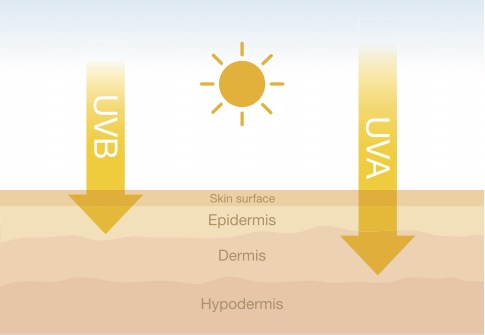
    Diagram of UVA and UVB rays reaching the skin

    UVA is the same strength, 365 days a year. To protect against damaging affects wear broad spectrum SPF’s every day, even in winter and swap the tanning beds for a bottle!

    Long term exposure of UV rays can trigger free radicals, creating an oxidative response. This response is seen as skin mottling, hyperpigmentation and age spots. Using products with added vitamins can reduce the risk of this stress on the skin as vitamins help to fight free radical damage.

    B: UVB

    UVB is considered the ‘burning ray’ it is much shorter and more intense than UVA. It’s UVB you can feel warming your skin when you are out in the sun and is at its most intense during summer months (particularly around midday) UVB has an accumulate affect when damaging the skin, the more your skin burns the more cells will mutate. These mutations can start to divide and multiply leading to skin cancer. skincancer.org states that 5 or more sunburns doubles your risk of developing life-threatening melanoma. (The Skin Cancer Foundation Official Website – The Skin Cancer Foundation, 2021)

    Top advice for protecting against burning:

    1. Apply SPF at least half an hour before exposure. This should be reapplied every 1-2 hours. The recommend amount is a teaspoon for the face and a shot glass for the body!
    2. Try UPF clothing. UPF clothing limits the number of rays coming into contact with the skin.
    3. Check the daily UV index and act accordingly. Reduce exposure during the hottest times of the day.


    UV index scale chart

    C: Cancer

    According to Cancer research UK 86% of skin cancer is preventable (Melanoma skin cancer statistics, 2021) So what causes skin cancer and how can we prevent it?

    Skin cancer or it’s official name Melanoma is the fifth most common cancer in the UK. Although not all types of melanoma are directly linked to sun exposer the majority of cases are, this is because UV rays damage the skin. This skin damage accumulates overtime particularly in cases where the skin has been burned, causing cell and DNA damage. This cell damage mutates into cancer and can grow.

    The fairer the skin the higher the risk for developing skin cancer, this is because melanin (natural skin colour) offers some protection against UV. The darker the skin the naturally more protected it is. Although it may not happen quickly, black and asian skin can still burn so it is still important to protect the skin with SPF.

    There are various types of skin cancers and although we are not in a position to diagnose cancer on our clients, it is good to have an awareness. This awareness can help us to draw their attention to changes in their skin or growths we may think they need to get checked. Always refer clients to their doctor for a diagnosis.

     A reference for skin changes:

    ABCDE signs of skin cancer chartAsymmetry: is it asymmetrical or does it have a jagged edge?

    Border: does it have a border?

    Colour: is it one solid colour or does it vary?

    Diameter: has it grown in the last few months?

    Evolving: has it changed shape or evolved in the last few months?


    Visit www.cancerresearchuk.org for more statistics and information relating to skin cancer.


    D: Vitamin D

     Although we have looked at the negative impact of UV on our skin it’s important to note that it does play a role in a positive contribution and that is in the production of Vitamin D. Vitamin D is important for healthy bones, teeth and muscles.

    The rate in which you produce Vitamin D depends on the amount of melanin your skin natural produces, the fairer the skin the faster it will produce the Vitamin. Most people in the UK do not produce enough Vitamin D during the winter months.

    Vitamin D can be supplemented through diet by taking supplements or eating foods such as oily fish, red meats, eggs and fortified breakfast cereals.

    For more references visit: 

    www.cancerresearchuk.org

    https://www.nhs.uk/conditions/vitamins-and-minerals/vitamin-d/

    https://www.skincancer.org/risk-factors/sunburn/


  • How can I make my client’s lashes last longer?

    How can I make my client’s lashes last longer?

    Lash technician applying eyelash extensions

    Choosing your adhesive 

    Choosing the right adhesive is vital when it comes to the retention of lashes, what works well for some lash techs may not work as well for others. This is because the adhesive that you use needs to work with you, your skills and your environment.

    If you’ve just started out with extensions choosing an adhesive that has a longer drying time (2-3 seconds) will give you the time needed to precisely apply the lash. When storing your adhesive ensure that it is stored in an airtight container and used within 3 months of opening, the longer the adhesive is exposed to air the faster it will oxidise.


    Consider your environment 

    Your environment places a crucial role, ingredients within adhesive are sensitive to both temperature and humidity. The ideal room temperature should be between 16 and 24°C and humidity levels between 40-70%. Using humidifiers and house plants may be the perfect solution for creating the right environment!

    Failing to prepare is preparing to fail

    Investing in a prep routine can increase adhesion and retention. Firstly, ensure all make up and oils are removed from the lashes. Most professional lash brands supply prep products, lash shampoos are a great way of preparing the lashes, they also make great link sell products to maintain the clients lashes at home in between visits!

    Check your angles

    When applying the lash ensure that it is placed parallel with the client’s natural lashes, if the lash is applied at an angle it may mean that it is not fully connected. Lashes that are applied incorrectly are at a much greater risk of catching and being removed.

    It’s also important to work with the clients natural lash, choosing the right width and length for the clients lashes will ensure that they aren’t under too much pressure. This can lead to drooping, lash loss and ultimately damage to the natural lashes.

    Aftercare

    How your client is treating their lashes between treatments can either support or be detrimental to their retention.

    Here’s our top tips for maintaining lashes at home:

    1. Avoid water within the first 24hrs (showers, swimming and saunas)
    2. Stay clear of oil based products and make up (oil will start to breakdown the adhesions!)
    3. Lightly shampooing the lashes can help to keep them clean and clear of oils, this is recommended every 2-3 days using a shampoo lightly with a soft application brush.
    4. Brush the lashes daily using a lash wand
    5. Avoid excessive friction to the eyes. Laying on your face when you sleep or rubbing/picking the lashes will make them drop off faster!


  • Which lash shield size should I use for Lash Lift treatments?

    Which lash shield size should I use for Lash Lift treatments?

    Lash Lift is certainly one of our most popular courses and highly lucrative earning you around £30-£45 per treatment. Many clients are moving away from the continued maintenance cost of lash extensions seeking a more natural option as the minimalism trend comes into make up and skincare this year. Lots of students complete our Accredited Courses to learn Lash Lift Skills but one tricky aspect to master is selecting the correct lash shield size and how to correctly fit the lash shield as it certainly takes time and practise to do this with confidence. Our blog covers best practice on selecting the correct size shield plus top tips for a successful lash shield application…

  • How to Make Brows Fuller & Less Unruly

    How to Make Brows Fuller & Less Unruly

    If windows are the eyes to the soul then surely brows are the frames? A great pair of eyebrows can really give a face structure. They can also help correct an unbalanced face shape or give the appearance of a more desireable face shape. When so many clients are investing in lash extensions right now, it would be wrong not to have the know-how to create flawless brows to finish the look. We give you the top 10 ways to make brows look fuller and groomed…

  • Keeping your Kit Tip Top – Storing Lash & Brow Tools…

    Keeping your Kit Tip Top – Storing Lash & Brow Tools…

    As any amazing lash and brow tech knows, you’re only as good as your products and tools will allow you to be. Not storing these correctly, not only shortens the lifespan of these causing wastage and extra costs but also limiting the results you can achieve. Here we discuss how you should be storing your kit…

  • How to Care for your Nail Products

    How to Care for your Nail Products

    As every good nail technician knows, you can only ever be as good as your tools allow. Once training is completed, the next biggest cost and one which will be ongoing throughout your career is the cost of your nail products and tools. To be successful in business you must reduce costs where possible by correctly using, storing and cleaning your products and tools. Our blog this week focuses on the essential know-how to do just that!

  • Get the Lighting Right

    Get the Lighting Right

    With the nights drawing into the afternoon as the winter arrives and the busy festive period approaches, it is more important than ever to ensure you have the right lighting on hand as a lash technician to not only ensure your work remains to the highest standard, avoid strain on your eyes but also maximise your working hours to fit in just as many clients. But many lash techs have no clue when it comes to selecting the best lighting set up for their working space. Our blog highlights just what you need…

  • How to Troubleshoot the Most Common Problems with Nail Extensions

    How to Troubleshoot the Most Common Problems with Nail Extensions

    Issues with nail extensions lifting or coming off prematurely as usually down to a number of specific reasons linked to incorrect application or improper home care by the client following application. We discuss the most common problems nail technicians will see and how to resolve here: